

Summary
Residuality theory is a revolutionary new theory of software design that aims to make it easier to design software systems for complex business environments. Residuality theory models software systems as interconnected residues - an alternative to component and process modelling that uses applied complexity science to make managing uncertainty a fundamental part of the design process.
For who?
This workshop is suitable for senior developers who want a head start into the world of architecture, for teams embarking on large, risk filled projects, and for seasoned architects seeking new techniques. It has also been successful in uniting teams around a common definition of architecture.
What you'll learn
This workshop teaches advanced, cutting edge techniques based on ongoing research that are designed to identify and decrease risk, improve confidence in decision making and protect your architecture when the domain is characterised by uncertainty.
The workshop introduces ideas on the philosophy of architecture, forcing participants to think outside of the technology and relate decision making to markets, culture, economic and societal concerns. It teaches practical techniques in stressor analysis and the use of matrices to make component decisions and gives participants the chance to work with these techniques in labs and groups.
Schedule
Part 1:
- Philosophy of Architecture
- Concrete Complexity for Software Engineering
- Representation in Architecture
- Residuality Theory
- Modelling stress: socio-economic architecture
- Defining residues
Part 2
- Surviving unknown unknowns
- Producing a real world architecture.
- Contagion analysis and component decisions
- Adjacency matrix techniques
- Incidence matrix techniques
- Testing the architecture
Prerequisites
Good understanding of software design. A laptop with Excel or another spreadsheet software will be necessary.
What participants say
"Barry's workshop was exceptional - a perfect 10! His engaging delivery and personality really brought the content to life. The material was insightful, challenging me to think about software architecture in new ways. I particularly appreciated learning additional tools for architecture discovery and stakeholder management. Overall, an invaluable experience for any software architect looking to enhance their skills."
- Yury Sukhoverkhov, Vita Management B. V. - workshop participant 2024
"I really liked how Barry brought together complexity science, statistics, and philosophy to explain the concept and reasoning behind residuality theory—and why it works. The workshop was very well-structured, and Barry was highly engaging. The lab sessions conducted throughout the workshop gave me a clearer idea of how to actually apply residuality and build architecture around it. I'm already looking forward to applying it in my daily work and challenging everyone, including myself!"
- S Jun, Software Engineer, Scania CV AB - workshop participant 2025
"The insights I gained, the great presenter (calm, good explainer, humor) - this workshop has already changed the way I analyse problems to come up with an architectural solution. The combination of theory and practical application was perfect."
- Peter Morlion - workshop participant 2025
Written by Barry O'Reilly - Published on Leanpub
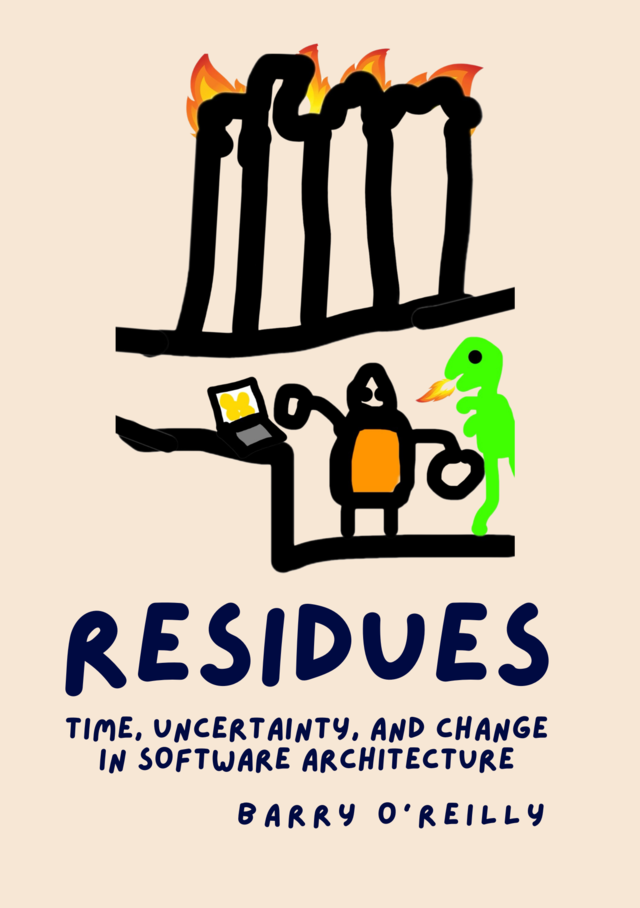
Residuality Theory is a new way to think about the design of software systems that explains why we experience design the way we do, why certain things seem to work only sporadically, and why certain architects get it right so often regardless of which tools they use. A new, scientific approach is defined that fuses Software Engineering, Complexity Science, and Philosophy to produce an entirely new way to think about how to design software. The result is a theoretical base that allows architecture to finally become its own discipline.
This book provides a short, easy introduction to the subject of Residuality Theory. A revolutionary new way to think about software architecture that fuses Software Engineering, Complexity Science, and Philosophy to provide an entirely new way to think about the problem of architecting software solutions.